Dear colleagues and friends,
As the year comes to a close, as usual we wish to take a moment to reflect on our journey and share our plans for the upcoming year. In this time grappling with uncertainty, we have tackled new projects, connected with many remarkable people, and gained invaluable insights.
Looking back and forward
Data Feminism
After laying the theoretical foundation for our focus on data feminism in recent years, 2025 was all about “bringing data feminism to practice.” The learning curve for Fempower Bot, a chatbot designed to train users in better communication on the topic of feminist development policy, was steep: We consulted all internal IT departments and focal points to obtain the necessary permissions to develop on Microsoft Azure – only to pivot to Hugging Face after many months due to circumstantial constraints. Nevertheless, we were able to connect many strands on the way and are delighted to be considered as one of the first projects to host on Nephele, the joint cloud between BMZ, GIZ and KfW – again an Azure-based environment, so let’s see how quick the process is going to go! Stay tuned! 😉
Data Powered Positive Deviance (DPPD)
In the area of Data Powered Positive Deviance (DPPD), a key milestone in 2025 was the transition of the Ghana DPPD activity on sustainable forest management in the Upper West Region into project implementation under DPPD Phase 4. Building on a data-driven identification of Positive Deviant (PD) and Negative Deviant (ND) communities, the project now actively brings together the most effective locally rooted practices – the so-called “golden mix” – by facilitating peer learning between PD and ND communities. This golden mix combines livelihood-oriented tree product processing, the use of trees for land demarcation, and community-based forest governance structures. In parallel, the Data Lab team finalized a comprehensive academic paper documenting the full DPPD process – from satellite-based forest cover analysis to qualitative fieldwork – which is currently under peer review in relevant scientific journals. The work is grounded in the broader challenge of climate change–driven forest degradation in northern Ghana and demonstrates how integrating Earth observation data with community knowledge can uncover scalable, culturally embedded solutions for climate resilience and sustainable land management.
AI in Negotiations
2025 has been the year in which AI truly entered the negotiation arena for us. Building on the early prototyping and first rounds of refinement in 2024, this year brought a level of development, scaling, and public visibility that would have sounded ambitious even a short while ago. We can say with confidence that our portfolio under the banner of “AI in Negotiations” has positioned GIZ – and by extension German development cooperation – as a front-runner in digital innovation. In short: The overarching “AI in Negotiation” asset encompasses several use cases that share a common foundation – building AI-assisted tools to support smaller delegations in complex, information-overloaded multilateral negotiation processes. This includes core functionalities such as automated negotiation-text summarization and extraction of key objectives, position comparisons, semantic chat interactions with documents, and interactive filtering features. With three use cases now live, we are actively shaping the field of negotiation-supporting AI systems and are currently exploring inclusion in the GIZ product portfolio. The momentum this year gives us both energy and curiosity for 2026, as we continue to grow while also charting pathways for our individual modules to stand on their own feet. We also want to acknowledge the close collaboration with our many partners and the strong networks that have grown around this product family – none of these results would have been possible without them (Rahkakavee Baskaran, Steffen Blume, Nadia Manasfi, Isabel Airas, Johannes Jacob, Yannik Saßmann, Gunda Ehmke, Christian Vorwerk, Raphael Leuner, Christa Castro, Huw Davies, Joaquim Barris, and many more!).
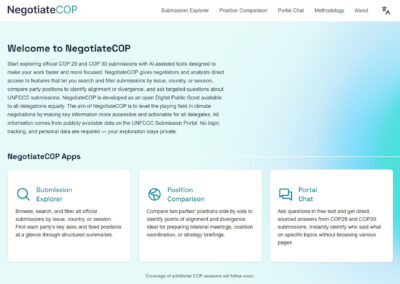
NegotiateCOP: In less than a year, we moved from the first brainstorming session to a functioning, scaled-up release of NegotiateCOP – launched just a week before COP30 in Belém. The joint effort between four Data Labs from three ministries (BMZ, BMUKN, AA) and GIZ marked a new step in cross-government cooperation, operating under a genuine “whole-of-government” approach. Presenting the tool on the ground in Belém to negotiators from smaller delegations and stakeholders from various backgrounds was a particular highlight. We returned with a treasure trove of user feedback, participation requests, and, naturally, improvement potential. In 2026, we look forward to the next development rounds, aiming to provide an excellent and comprehensive tool for all delegations ahead of COP31./p>
NegotiateAI: The successes and spin-offs described above were only possible because we continued to believe in NegotiateAI – our original prototype for the UN plastics negotiations – and kept improving it. This year, we introduced NegotiateAI at INC-5.2 in Geneva and gathered valuable insights into how negotiators actually use the tool. While our app could not resolve the political stalemate in the negotiations (the session has been adjourned without an agreement…), we are committed to delivering an even more powerful, robust version ahead of the extended INC-5.3 session. We would like to thank our partners and colleagues in the Global Sector Programme ‘Litter-free Oceans’, who support the Federal Ministry for Environment, Climate Action, Nature Conservation and Nuclear Safety (BMUKN) in the negotiations on the plastic treaty, among other things. Thanks to their enormous efforts, we were able to connect the dots and co-create the app’s design in close collaboration with the actual needs of the negotiators.
MontrealAI: A targeted spin-off focusing on one of the core features across our negotiation-AI tools, which is based on a database of decisions and annexes of the Multilateral Fund of the Montreal Protocol, is being developed to enhance knowledge management and research through a chat interface. This is done with the initiative of BMZ mandated Proklima and in close collaboration with our colleagues at the Data Service Center. It demonstrates how essential this functionality has become and how GIZ pioneering role is inspiring the development sector beyond the German cooperation now are across negotiation contexts.
Computer Vision E-Waste Ghana
Together with the eWaste Project “Umweltgerechte Entsorgung und Recycling von Elektroschrott” in Ghana we started an experiment as to whether an eWaste image recognition application would be 1) technically feasible and 2) usable for scrap workers on Ghana’s scrapyards (and possibly beyond). Our research revealed that no existing eWaste database matched the specific context we were working with. Therefore, we decided to undertake a field trip to Ghana ourselves to create a database (aka taking pictures fit for the computer vision model on the scrapyards) and refine our use case with on the ground consultations at scrapyards in Accra and Kumasi. We realized that an essential step was building on existing relationships which we could do thanks to our local consultant David Aladago. The direct conversations with scrap workers were the highlight of the trip. Currently we are working on labeling images and selecting suitable algorithms. Let’s see what 2026 has in store for this experiment.
New Website
As you may have noticed, our website underwent a major overhaul this year, thanks to Damian Paderta from NOZILLA, and we are thrilled with the results. Our objectives were to declutter the site, modernize the design, and create a clearer structure. We are still fine-tuning some details and would love to hear from you if you encounter any issues or feel that some content is missing. Looking ahead to 2026, we plan to continue our regular updates through blog posts and working out loud, while also expanding our benchmark posts with more in-depth background articles.
Events
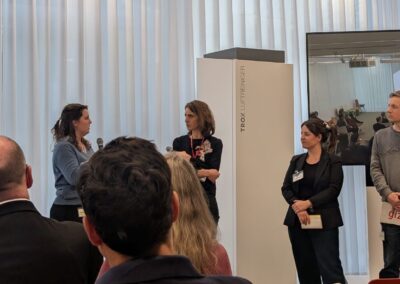
Vanessa visited the AI for Good Summit in July in Geneva and her takeaways are: The event has evolved from a mere robotics-fair to a meet and greet for all important stakeholders on the AI scene. And sometimes, unofficial side-events can bring the biggest added value: “AI for Peace” co-organized by Foreign Office’s Data Lab was a true eye-opener!
We contributed a keynote at “AI for a Greener Future”, hosted by the PlasticObs+ consortium, where we discussed the potential and the risks of AI in environmental policy. Using NegotiateAI as an example, we showed how AI can help structure and navigate complex international plastics negotiations. Robin also contributed a session with a live tech demo at the AI4Development Summit in Barcelona. The presentation sparked strong interest in NegotiateAI and in the broader idea of using AI to support multilateral negotiations. It was energizing to see how many participants recognized the tool as a mature and relevant innovation emerging from the GIZ Data Lab.
Anna-Lisa held the Key Note on Data Feminism at the Data Tank Youth Social License Toolkit Launch in Berlin in February. She underlined the importance of the 7 Data Feminism principles in our work, showcasing several international projects.
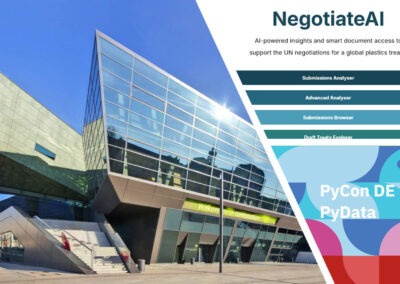
In April NegotiateAI was presented at PyCon 2025 in a technical talk by Anna-Lisa and our external consultant Rahka from &effect data solutions. The method used for the application, Retrieval-Augmented Generation (RAG), is an approach in which an AI system dynamically consults relevant internal or external data sources during response generation, ensuring its outputs are accurate, context-aware, and aligned with the most current available information. In the case of NegotiateAI for the UN Plastic Treaty Database. NegotiateAI was commended and the presentation room was filled as it represents one of the first practical applications of the RAG method in the (international) public sector.
Team
After more than three years filled with successful projects, fruitful conversations and great team moments, Vanessa Hochwald will leave the Data Lab for a new exciting position inside GIZ. Vanessa has left a huge footprint on the Data Lab, has advanced the Data Feminism agenda of German development cooperation considerably and will be dearly dearly misssed. Thank you, Vanessa, for being such an inspiration, a wonderful colleague and such a fun person to work with.
We wish you all the best.
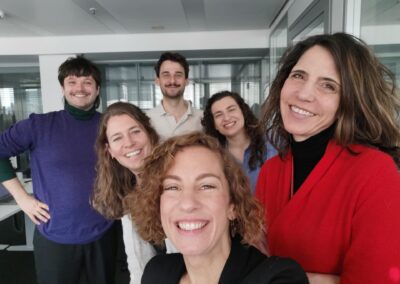
The team consisting of Anna-Lisa Wirth, Teresa Kroesen and Robin Nowok and led by Catherine Vogel, will continue to advance the responsible use of data and artificial intelligence in 2026.
In 2025 we enjoyed the collaboration with our genius colleagues Lucas Braun, Yuri Irrgang and Claire Ott as our heads of support. We wish they could (have) stay(ed).
Finally, we extend a heartfelt “Thank you” to our amazing partners and collaborators. Your unwavering support and innovative ideas have been the cornerstone of our achievements. As we move forward, let’s continue to explore new avenues and drive impactful change together. Reach out via datalab@giz.de if you have questions or ideas!
Let us support the movement from pilots to scale, let’s give more attention to the climate impact of AI, let’s discuss when to use it and when not, let’s talk about infrastructure in the global south, let us uphold the feminist principle “no discussion about us, without us” and stop organizing events which don’t have an essential participation of representatives of low income countries. Let’s look at market concentration, the AI divide, and AI literacy. But let us also look at AI driven ways to protect the climate, cooperate with local AI ecosystems, celebrate AI based capacity building where there is no other system in place and the potential of increasing evidence and efficiency in development cooperation in order to increase the impact for our partners.
Here’s to a data-driven 2026, brimming with creativity, collaboration, and meaningful progress!
Your GIZ Data Lab,
Anna-Lisa, Catherine, Claire, Robin, Teresa and Vanessa